Your Health & Well-being#
Your student visa confers access to the National Health Service (NHS), the UK’s healthcare system. NHS healthcare is free, except for certain things like travel vaccination or insurance certificates. You will have been issued with a NHS number with your visa and you may be asked to present this number when accessing healthcare, so keep a record of it to hand. As soon as you have settled into the College, you should register with a General Practitioner (GP) medical practice. This will be your first point of contact for health issues throughout your time in the UK. Do it as soon as you arrive - don’t wait until you are unwell!
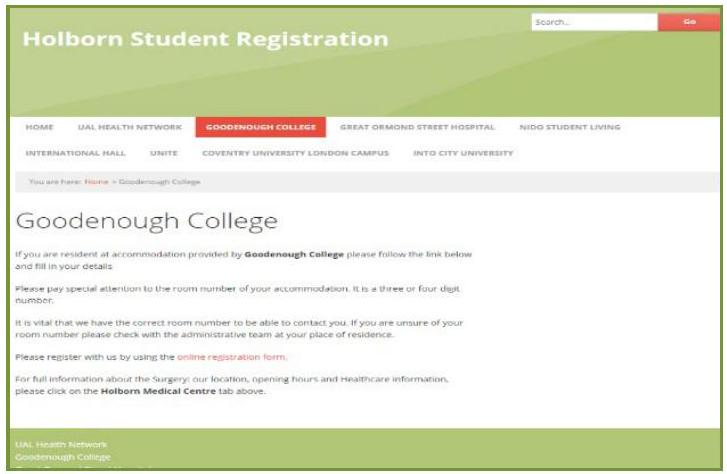
For useful information on the National Health Service (NHS) and GPs, as well as dentists and opticians near the College, go to: http://www.nhs.uk/servicedirectories/Pages/ServiceSearch.aspx. Goodenough College has a special arrangement with a local doctor’s surgery to help get Members registered for medical services as quickly as possible. They are Holborn Medical Centre (www.holbornmedicalcentre.com), just round the corner form the College at 64-66 Lamb’s Conduit Street, WC1 3NA (telephone: 0203077 0044). They have a good reputation and are very experienced. You can register with them online at www.holbornstudenthealth.com/registergoodenough
The registration form asks first for your postcode: if you live in London House, it’s WC1N 2AB and if you live in William Goodenough House, it’s WC1N 2AN. Fill out your address as follows:
| First Line: | Room/Flat Number, London House [or William Goodenough House] |
|---|---|
| Second Line: | Mecklenburgh Square |
| Town: | London |
| Post Code: | WC1N 2AB [or WC1N 2AN for William Goodenough House] |
If you are a couple or family, you will have to do separate registration forms for each adult. To register children, you will have to complete forms at the Medical Centre.
After registering, you will receive an NHS Medical Card for Holborn Medical Centre by mail. It takes 4-6 weeks for the medical card to arrive.
Each year, Holborn Medical Centre participates at the College’s Clubs and Societies Fair to register Members and answer questions you may have regarding health care. So if you have any queries or want to register with them, visit their table.
If you feel unwell while in College, you can:
- go to Reception, where there is always a First Aid-trained member of staff on duty;
- make an appointment with your GP (General Practitioner); or
- call 111. This is an NHS helpline and they will ask you questions about your symptoms and give you advice about your condition. If it is necessary, they may get a doctor to call you back, or make an appointment for someone to see you immediately, or advise you where the nearest pharmacy is or, in extreme circumstances, call an ambulance. It is a really good service. (There is an advice line specifically for COVID, which is 119 .)
- talk to a pharmacist. The nearest pharmacy is Boutalls Pharmacy in Lambs Conduit Street but it is only open on weekdays. Boots Pharmacy in the Brunswick Centre has longer opening hours and is open at the weekends. They will be able to advise on medications, including the names of these medications in the UK.
- Go to the Accident and Emergency Centre. The nearest is University College Hospital which is a 20-minute walk away. Reception can call you a taxi.
- in an emergency, phone 999. 999 should only be used in a medical emergency, when you are seriously ill or injured and your life is at risk.
I need an Appointment with a Specialist#
Under the NHS system, you can’t make an appointment direct with a specialist. You need to see your GP and they will refer you to a specialist.
Can I choose Private Healthcare?#
Yes of course. There are many private GP services you can visit or who run an online or phone consultation service. If you want to see a specialist privately, you can review a wide range of providers on the internet.
Prescriptions#
If your doctor prescribes a medicine (they will give you a paper prescription certificate), you must go to a pharmacist to collect it. You will have to pay for most prescriptions: the current cost is £9.35. People with chronic illnesses may be entitled to free or reduced price prescriptions.
Dentists#
A few dentists take patients under the NHS but most primarily offer private (paid) services. You will have to approach a dental surgery to see if they are accepting NHS patients. Otherwise, for most dental care, you will need to pay the dentist’s fees yourself
Local dental practices include: Conduit Dental Practice Gandhi & Chan Dental Surgery Dental Smiles
Opticians#
Most opticians operate from specialist shops like Boots Opticians, Dolland and Aitchison or Vision Express. You can get a discount on your eye test if you use the NHS but you must pay for glasses or contact lenses. You may want to check the reviews online for an optician or branch before you book an appointment.
Medical Insurance#
Even if you are entitled to free NHS treatment whilst in the UK, you should consider taking out insurance which covers other medical-related costs. An insurance policy may cover, for example:
- lost fees if you are unable to complete your course;
- costs of returning home if a relative is ill;
- costs of a relative visiting you in the UK if you fall ill;
- cost of returning to your home country for treatment;
- or, in the worst possible situation, returning a body home for burial.
There is often a long wait for NHS treatment, sometimes many months. An insurance policy which gives you access to private medical care could give you much quicker access to the treatment you need.
If you already have medical insurance in your home country, check whether you can extend it to cover your stay in the UK, as well as looking online at options available from UK insurers.
Coronavirus (COVID-19) vaccination#
Getting fully vaccinated gives you the best protection against coronavirus. If you have not started vaccination yet, you can contact the Holborn Medical Centre to get a vaccination as soon as you have finished your online registration with them or you can go to a number of walk in centres locally. You do not need to wait for registration with the NHS to start your vaccinations.
Meningitis (and Septicemia)#
Meningitis is an illness caused by bacteria or viruses. Whilst viral meningitis can be very nasty, it is almost never life-threatening and most people will soon make a full recovery. Bacterial meningitis is more serious and most cases are caused by meningococcal bacteria. These bacteria also cause septicaemia, the blood poisoning and far more threatening form of the disease. The illness tends to affect children and young adults and you may hear of cases amongst students. Students on higher education courses in the UK are likely to be offered a meningitis vaccination by their university when they start their course. The vaccination protects against one of the common strains of the disease, but does not protect against all strains of the illness. Most institutions and GP surgeries have information about how to recognise the symptoms of meningitis. There has been a concerted effort in recent years to make students aware of this illness. When detected early it can be effectively treated, but if allowed to develop it can be fatal.
MMR (Measles, Mumps and Rubella)#
There have been small outbreaks of mumps and measles within UK universities in recent years among unvaccinated students. Measles is a very infectious viral illness that is spread by coughs and sneezes. Mumps is a viral illness that is spread by coughs and sneezes or close contact with someone who already has the infection. Both illnesses can also have potentially fatal complications. Rubella is a viral illness, now rare in the UK, and is spread in a similar way to mumps and measles. For most people, it is usually a mild condition; however, if pregnant women develop rubella it can be very serious for their unborn baby.
The MMR vaccine is safe and effective and protects against all three illnesses in a single injection. To ensure you are fully protected, you require two doses of the vaccine; it is likely that you would have received the two doses as an infant but it is advisable to check with your GP before arriving at university. If you have not had two doses of MMR you should make sure you receive them as soon as possible.
The Common Cold#
The common cold is caused by a virus that irritates the nose and throat, causing sneezing and coughing. It is a very common illness in the UK in the winter months. There is no effective cure for the common cold. However, getting plenty of rest, and drinking plenty of non-alcoholic fluids and fruit juices, will aid recovery. A cold will usually pass after a few days. However, if symptoms get worse, or the cold lasts for a long time, you should consult your GP.
Many British people continue to work or attend classes when they have a cold but this not advised during a pandemic as you may find it difficult to distinguish between a cold and COVID. You may recover more quickly, and reduce the risk of passing on the virus to fellow students, if you stay in bed and do not attend classes until you are feeling better - but don’t forget to tell your tutor or the institution that you are ill.
Sexual Health#
In the UK, it is often accepted that people who are involved in a relationship may have sex. Of course, the choice is a personal one. You are entirely free to live according to your personal standards and should not feel pressured to adopt those of your fellow Members. If you need sexual health advice, screening, or tests for sexually transmitted infections, you can go to the GP, the local pharmacy, send away for confidential online tests or visit your university Student Health Centre.
Sexual Consent#
Enthusiastic sexual consent (both giving and getting) is a crucial part of all sexual interactions and contributes to respectful, equal and fulfilling relationships. Any sexual activity that occurs without consent is against the law. Consent is legally defined as agreeing by choice, and having the freedom and capacity to make that choice. This means that consent is active and includes a freely given and informed yes, verbally and through actions and body language. No one deserves to experience any form of sexual violence or harassment. It is never the survivor’s fault: sole responsibility and blame lies with the perpetrator.
Freedom to consent means doing something because you wish to. A person is not making a free choice if:
- they or someone else is being threatened and/or intimidated through fear and violence;
- they felt forced or pressured/coerced into making a decision;
- they are being blackmailed in some way, e.g. using images or social sabotage;
- there is a power imbalance between two people; for example due to age, status/position and/or authority or a dependency (e.g. drug/alcohol use, financial control).
Capacity to consent is about whether you are physically and/or mentally able to make and fully understand the consequences of that choice. A person does not have the capacity to give consent if:
- they are drunk or high on drugs;
- they are asleep or unconscious;
- they are under 16 years old;
- they have a disability which results in them being unable to make a fully informed choice at that time.
Other things to consider:
- Consent is not a one-off discussion - it needs to be negotiated every time you have sex and also during sex as you start to do different things, regardless of any previous sexual activity;
- Consent may be withdrawn at any time (including during sex) and can never be implied, assumed or coerced.
All Goodenough College Members are asked to undertake online modules in consent and being an active bystander. You will be sent details of these soon after joining the College. At the end of this module you will also have access to information who to contact for advice or help if you should need it.
Contraception#
If you become involved in a sexual relationship, you may wish to consider how you will avoid pregnancy. You can get advice on contraception from your doctor, online or from a local Family Planning Clinic (FPC). Your universities welfare service will have details of where to go. Using a condom as a form of contraception can also prevent the spread of sexually transmitted diseases between partners. Condoms can easily be bought from chemists, public toilets, supermarkets, petrol stations and online and are also available at the College Reception (look for the spotty tin).
HIV/AIDS#
AIDS (Acquired Immune Deficiency Syndrome) is caused by HIV (Human Immuno-deficiency Virus), which can affect the body’s normal defence against illness. The virus is passed on by an exchange of body fluids, through unprotected sexual intercourse with an infected partner (of the same or the opposite sex), by sharing needles and drug injecting equipment, and from an infected pregnant woman to her child. Using a condom can reduce the risk of HIV/AIDS in sexual intercourse. Some people carry HIV for a number of years without developing AIDS or showing symptoms.
You are not at risk from HIV/AIDS from: sharing food, drinks, clothes, crockery or toilet seats; shaking hands; coughing, sneezing or day to day contact with an infected person. If you are concerned about the risks of AIDS, or want to talk confidentially, you can contact the telephone helpline at the Terence Higgins Trust.
Treatment for HIV/AIDS is usually free, even if you would not normally be entitled to free NHS hospital treatment.
Well-being and looking after your mental health#
Arriving at Goodenough College and London, starting a postgraduate degree and forming new friendship groups can be a very exciting time but it can also be very unsettling if you’re adapting to a new climate, anxious about starting a postgraduate degree, potentially speaking in a different language and feel far from your friends and family.
If you notice yourself becoming stressed, anxious, suffering from a ’low’ mood, unhappy or depressed there are some steps you can take to help overcome these feelings
- talk to people including friends, friends from home, family, your personal tutor or other support staff at your university, or staff at Goodenough
- don’t be embarrassed or ashamed to discuss these feelings with others. You are not alone and there is no stigma
- don’t isolate yourself - go outside and into public places
- set yourself routines and stick to them. Try to incorporate exercise into these routines. Exercise outside is even better! Think about running or walking just two laps of the Garden in the mornings.
- go outside especially if you have come from a country where you are used to longer hours of daylight and more intense sunlight. The lack of light can have a negative effect on our mood. You have arrived in the UK just as the days are getting shorter and by Christmas there will be only 8 hours of daylight and sunset will be around 4 pm . The lack of light can have an effect on mood and energy levels. The most intense daylight in the UK in the winter is before noon. Eat more vitamin D rich food in the winter - salmon, tuna, sardines, egg yolks, fortified cereals or consider a supplement.
- get enough but not too much sleep.You can determine how much sleep you need by monitoring what time you go to sleep and what time you naturally wake up in the morning. On days when you have no morning appointments don’t set an alarm and monitor what time you wake up. If you do this a few times you will start to see how much sleep you need each night. A normal amount of sleep for adults is between 7-9 hours. Too much sleep can make you feel lethargic.
- if you are having trouble sleeping try to set up a good sleep routine. For 30 minutes before you are going to sleep set a routine so your brain and body get used to the idea that soon you will be going to sleep. Do something relaxing like reading a book, listen to a podcast or audiobook, dim the lights or try a body scan meditation. Don’t use phones, laptops or tablets - the blue light from these suppresses the release of melatonin which is the hormone that controls your daily sleep-wake cycles. Avoid caffeine, nicotine, heavy, rich, fatty, fried, spicy food, citrus fruits or carbonated drinks which can either be stimulants or cause indigestion when lying down.
When and where to go for help?#
It’s normal to feel down, anxious or stressed from time to time, but if these feelings affect your daily activities, including your studies, or don’t go away after a couple of weeks, get help. Signs of depression and anxiety include feeling low, feeling more anxious or agitated than usual, losing interest in the things you normally enjoy or do or losing motivation.
Some people also put on or lose weight, stop caring about the way they look or about keeping clean, do too much work, stop attending lectures, become withdrawn or have sleep problems.
There are sources of help available to you#
Goodenough has paid for special service for College Members which is available 24 hours a day. Student Assistance Programme - 08000283766 (Username: Goodenough Password: College). Health assured also have an App available on Apple or Android and it is called My Healthy Advantage app (iOS and Android). You need to enter the code MHA142463 when prompted. They have many services available and their calls are answered by mental health counsellors. You can also ask them for access to the face to face or online counselling services they provide.
- Most universities and college have a free and confidential in-house counselling service
- Your university or college may also have a mental health adviser
- Go to your GP
- There are student lead services. Goodenough subscribes to Nightline which offers confidential listening, support and information from 6pm to 8am during term time
- Uniheads - Online mental health training for students
- Shout - Shout 85258 is a free, confidential, $24 / 7$ text messaging support service for anyone who is struggling to cope.
- Kooth - free, safe and anonymous support for young people aged between 11 and 25
- Student Minds - the UK’s student mental health charity
- Student Space - wellbeing resources and advice
- The Wellbeing Thesis - an online resource for postgraduate research students to support your wellbeing, learning and research
- You may prefer online self-help such as websites such as NHS Choices’ Moodzone or Students Against Depression
- If you think you may be having trouble adapting to living in the UK or away from home then you might want to find out more about culture shock
- Goodenough does not have trained counsellors but you can reach out to staff - all of the following would be more than happy to spend some time with you -Caroline (Registrar), Alan (Dean), Iwona (Deputy Registrar) Ljiljana (LH Administrator) or H Administrator).
- If you would prefer to speak to a College member then there are Community and Welfare Co-chairs on the Members’ Council.
What to do if you see someone else suffering or they have told you they are thinking of harming themselves?#
Many people struggle to cope at one point or another of their lives. You might notice that another College Member seems to be more restless and agitated, is tearful, does not want to be with other people when they were normally sociable or is not replying to messages or is sending an excessive amount of messages. A College Member may have opened up to you that they are feeling depressed, have financial, family, relationship, academic or other worries or they have had thoughts of taking their life (suicide).
If you find yourself in this situation you should talk to them about their feelings. There is an advice on having a difficult conversation. Encourage them to contact the Samaritans. They can call on 116 123, email jo@samaritans.org or visit the local branch in person. If they need advice on a particular issue, they can get in touch with one of these specialist organisations. You can contact The Samaritans on their behalf. If you call or email, they can reach out to them and they won’t tell them you asked them to do that unless you want them to.
If you think someone is in immediate danger, you should call an ambulance on 999. Please always reach out to staff at Goodenough for help. If it is an emergency or out of office hours ask to speak to the Reception Supervisor who will know what to do and can contact other staff.
Looking after yourself#
Supporting someone in distress can be distressing in itself. If you’re helping someone who’s struggling, make sure you take care of yourself as well.
If you need to talk about how you are feeling, please call Samaritans on 116 123, or email on jo@samaritans.org, whenever you need.
Please be assured that if you feel anxious, unsafe or isolated during the night or weekend the College is here to support you. Here is a flow chart to guide you.#
STUDENT ASSISTANGE PROGRAMME#
24-hour support online or phone. A trained counsellor is here to help you talk through your situation and arrange for you to access free shortterm therapy sessions.
Number 08000283766.
Website:#
www.healthassuredeap.com#
The username and password to enter the health and wellbeing portal is:
Username: Goodenough
Password: College
What Happens Next? you have to offer to the College and the world!
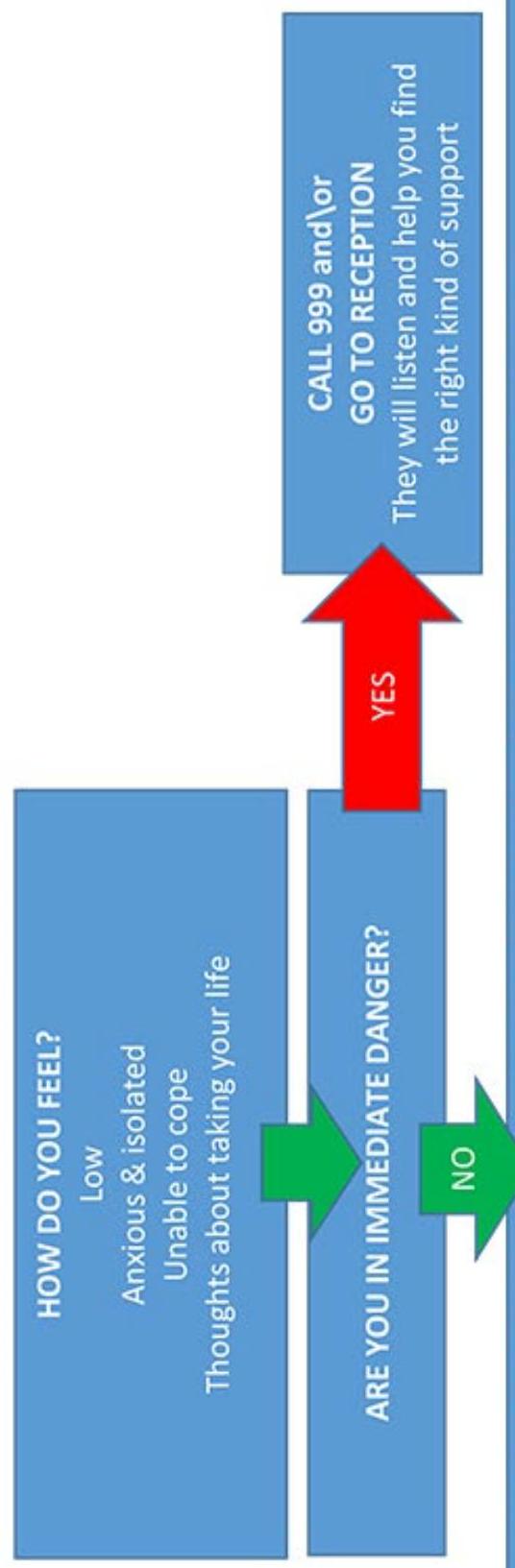
HERE ARE THE FOLLOWING OPTIONS THAT ARE AVAILABLE TO YOU DURING THE NIGHT:#
SAMARITANS#
An expert, well-trusted, confidential and nonjudgemental service for people who are struggling in any way. https://www.samaritans.org /how-we-can-help/contactsamaritan/
Call: 116123 for free Open: 24 hours a day, 364 days a year.
NIGHTLINE#
A confidential and anonymous listening and practical information service run by students, for students of the University of London and beyond.
https://nightline.org.uk#
Instant chat on their website#
Email: listening@nightline.org.uk
Text: 07717989900 Open from: 6pm to 2am in term time
NIGHT RECEPTION. Our night time supervisors have received training in Mental Health first aid. Please feel able to phone or visit them. They can help you talk and keep you safe until the morning when we can help you seek further support. Senior Duty Officer is on call 24 hours a day, 365 days of the year who will be of assistance and will follow up any concerns. In the morning you can contact Alan
999#
If your situation is acute then call the emergency line 999. You will be assessed and they will advise you on the next steps.
McCormack, the Dean or Caroline Persaud, Registrar. They will be able to meet up with you face to face and help you in the longer term. Welfare Co-Chairs from the Members’ Council are also here to support you. Please remember the Goodenough College tries to be a loving community. We care about your safety, health and the gifts